Night on Lake Kivu: Local Explorers Map Methane Seeps with DIY Submarines
By headlamp and oar, a Rwandan–Congolese crew turns Lake Kivu into a midnight lab—piloting home‑built ROVs to trace methane seeps, listen for bubble plumes, and chart the lake’s volatile depths.
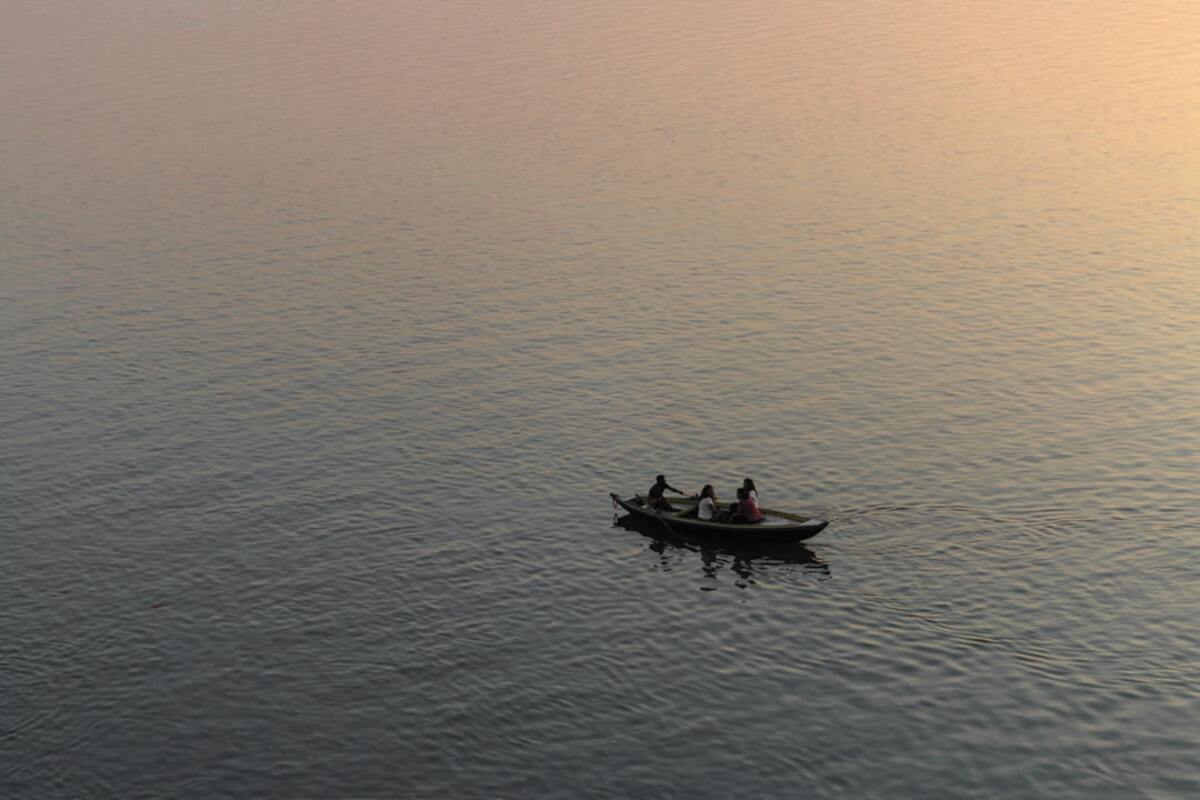
- A local, human-powered team uses low-cost ROVs and fish finders to locate methane bubble plumes on Lake Kivu at night.
- Open-source tools and careful safety protocols make big-lake exploration accessible to non-specialists.
- Community mapping supports fisheries, informs gas extraction, and helps monitor the lake’s limnic eruption risk.
Just after dusk, the shoreline of Lake Kivu flickers to life. Lanterns bloom above the water as small wooden boats push off into the dark, their crews heading for night nets and deep-water moorings. Among them is a boat that looks almost ordinary, except for the tangle of cables, a bright orange case humming softly, and a small robot the size of a backpack resting on foam blocks. The lake is calm, but in the minds of the crew, it is alive with pressure, chemistry, and stories. They are night explorers. Their quarry is invisible by day, but under headlamps it glitters: trails of bubbles rising from the deep, threads that hint at the gas held in Kivu’s layered waters—and at the promise and peril of an explosive lake.
Lake Kivu, straddling the border of Rwanda and the Democratic Republic of the Congo, is one of the most unusual lakes on Earth. It holds vast reserves of dissolved methane and carbon dioxide stored at depth, a natural outcome of volcanic activity, geothermal inputs, and biological processes that have been building for centuries. The lake’s delicate balance makes it simultaneously a potential energy resource and a rare hazard; a limnic eruption, like the one that killed thousands at Cameroon’s Lake Nyos in 1986, is exceedingly unlikely here yet theoretically possible. That dual nature has turned Kivu into a focus for scientists and engineers. It has also sparked something else: a grassroots exploration culture on the water, led by fishers, divers, and tinkerers who are learning to read the lake as intimately as a sky full of constellations.
On this particular night, the team is led by Aline, an electrical technician from Gisenyi who learned to solder at a bicycle repair stand. Beside her, Mumbere, a boatman from Goma, checks knots and knots again; lines are the difference between a successful mission and a very expensive anchor. Their small crew calls itself a collective rather than an expedition—a nod to the fact that the boat, the sensors, and the code are all owned, built, and maintained by the community. Their robot is a DIY remotely operated vehicle—an ROV—born from open-source plans and a patchwork of parts: thrusters from a hobbyist supplier, a pressure canister machined in a local shop, a Raspberry Pi running navigation code, and a simple umbilical tether that also carries live video back to a laptop inside the orange case.
Why Kivu’s Deep Waters Matter
On paper, the physics of Lake Kivu seems straightforward. Over time, volcanic gases and biological activity charge deep layers of water with methane and carbon dioxide. The lake is strongly stratified; surface waters do not readily mix with deeper layers. As a result, the methane stays trapped until it can be drawn off for energy via extraction barges, or slowly released through bubble plumes where fractures and seeps connect to the deep reservoir. In practice, this system is anything but simple. Tiny changes in temperature, wind patterns, seasonal inflows, or seismic tremors can nudge the balance. Fisheries depend on these dynamics, because nutrient cycles and oxygen levels shift with the lake’s internal breathing. So do coastal communities, which are invested in both safety and the opportunities of gas-to-power projects.
Formal projects monitor the lake with anchored instruments, regular sampling campaigns, and professional ROVs. But just as birders can help track migrations that escape a single research team’s schedule, Kivu’s night explorers fill gaps with frequent, nimble surveys. They cannot sample every depth across the basin, yet they are everywhere people launch a boat. They talk to fishers who report unusual bubbling. They revisit points where bubbles burn when a match is held above the water—an old, risky demonstration they have replaced with safe sensor checks. And they keep a record: a hand-drawn map turned digital, dotted with colorful pins where the lake speaks loudest.
For the explorers, methane is both a subject and a signal. They cannot directly measure gas concentration at depth with lab accuracy, but they can triangulate it by detecting bubble plumes on sonar, measuring dissolved oxygen and temperature gradients, and filming microbubbles that rise from the bottom. They pair a small hydrophone to listen for the crackle of plumes—each rise and pop rendered as fizz on a spectrogram. Over weeks and months, patterns emerge: some seeps wax and wane with lake level; others awaken after distant rumbles; still others are constant, predictable as stars.

Inside the DIY Submarine
Their ROV is designed for simplicity and repairability. In the early days, a single thruster failed and the robot yawed like a kite; the crew learned to carry spare propellers and an extra speed controller. They added a mechanical claw, not to pick up treasure but to place small bubble traps on the lake bed—clear funnels that capture rising gas, allowing its volume to be estimated over time. A snorkel-like tube leads from the trap to a low-cost gas sensor fixed near the surface, where readings are safer and electronics are happier.
On every mission, the ROV’s limitations shape how the team explores. The tether is their lifeline and their leash. It tangles easily, so one person does nothing but tend the line, coiling and uncoiling to the rhythm of the robot’s dance. Strong currents are rare on Kivu, but wind can push the boat; they use a sea anchor to stay in place while the ROV hovers. Light matters, too. Bubbles are easier to see against darkness, but lake life is sensitive. They run only as much illumination as the camera needs, switching to red light when they can.
| Component | Spec | Reason for Choice |
|---|---|---|
| Thrusters | 6 × 1.5 kg thrust brushless | Stable hover for filming microbubbles and placing traps |
| Control | Raspberry Pi + IMU; 200 m tether | Open-source code; easy to repair; reliable wired link |
| Camera | 1080p low-light + red LED ring | Minimize fish disturbance; clear view of bubble streams |
| Sonar | Compact fish finder (200 kHz) | Detect plume columns and anchor without heavy gear |
| Sensors | Temp, DO, conductivity; surface gas sensor | Track stratification and infer gas dynamics safely |
| Power | Lithium pack, fused; boat battery backup | Redundancy and longer night missions |
Safety is not negotiable. No one dives. No one leans too far over the gunwale to recover a stuck trap. There is a standing rule: if wind rises above a threshold or lightning is seen, the mission ends. If bubbles appear around the boat unexpectedly, the crew shifts slowly and across the wind to avoid drawing any gas under the hull. Their training includes drills on how to clear a fouled prop, how to switch to paddles if the outboard dies, and how to signal shore with a flashing headlamp in the pattern their families agreed upon. Every member can navigate by stars and by the pattern of dark ridges against a paler sky.
The Night Missions
Most mapping runs follow a beat the crew knows by heart. The rhythm blends engineering with intuition learned from years on the lake.
- 19:30 – Briefing and checklists: weather, batteries, tether, spare fuses, bubble traps, food, tea.
- 20:15 – Launch from a quiet beach; row clear of nets; power up fish finder and hydrophone.
- 21:00 – Drift-scan transects; mark anomalies where sonar shows pillars of rising bubbles.
- 22:00 – First ROV drop; shallow hover to confirm visual bubbles; place a trap if the plume is steady.
- 23:30 – Second and third stations; collect water samples near the thermocline for later lab checks.
- 01:00 – Data review underway; backup logs; head in slowly, avoiding bright lights near shore.
On-screen, a plume looks like drizzle in reverse, each echo a fleck of bright where a bubble reflects the sonar ping. When the camera noses in close, the picture changes. Bubbles spiral and merge, coated in a sheen of microscopic life; sometimes they carry filaments of milky biofilm that wave like grass. Where the lakebed seeps are strongest, the ROV’s lights reveal a patchwork of textures: coarse sand that trembles, silty fans that breathe in rhythm with rising gas, and, once, a shard of volcanic rock shaped like a storybook mountain. The crew leaves it in place; this is a lab, not a museum.
Not every mission is a parade of excitement. Some nights, the lake is silent. The team logs the quiet as carefully as the fizz, because absence matters: equipment works; conditions are stable. They compare notes by week and by season, overlaying their pins on satellite wind maps and the operating schedule of gas extraction barges. The goal is not to prove causation—the data are too thin for that—but to spot patterns worth sharing with researchers and managers who can test hypotheses with heavier gear.
Aline, who has a gift for turning readouts into stories, keeps a small notebook where she translates numbers into sketches. On one page: a drawing of stacked blankets for the lake’s layers, with arrows showing where nutrients creep upward. On another: the path of an eastern breeze that, over days, changes surface temperature by a fraction but moves enough water to tilt the thermocline. These sketches are not art for the gallery; they are field tools. When a fisherman asks why the crew cares about a new bubbling patch near his nets, she shows him a page: bubbles mean gas, gas can mean change, and change can pull oxygen from fish waters if layers mix in the wrong way. The answer is not to avoid that spot, but to know it. Nets are moved. The crew marks the plume for a follow-up drop.
Occasionally, their work brushes against myth. People tell old stories about fire on the water, about nights when a match lit on shore and the flame walked across the lake, about the lake’s mood when the mountains grumble. The explorers listen. They do not chase fire. Instead, they anchor those stories with repeatable observations, mapping where seeps actually breathe and how much. In the collective’s open data sheet—simple rows of dates, coordinates, plume strength, and notes—there are columns for “community tip” and “follow-up.” More than once, a tip led to a discovery that would have been easy to miss in a gridded survey.
This community map is not a challenge to formal science; it is a companion. The team shares monthly summaries with university labs, conservation groups, and the operators of extraction barges. In return, they sometimes borrow a lab bench to calibrate a sensor, or receive training on how to calculate dissolved gas proxy values safely. On a few proud days, their ROV joins a professional one on the same transect; the images line up, and the little robot holds its own.
What keeps them on the water is not only the thrill of exploration. It is the lake as neighbor—a presence that breathes through their days and nights, their kitchens and markets, their songs. Their exploration is a form of stewardship, a way of paying attention. They speak of methane seeps as thresholds and edges—places where unseen processes become visible. They speak of data with warmth, as another kind of story the lake tells when you learn the language.
What the Explorers Are Finding
After months of night runs, certain findings recur. The strongest bubble plumes often align with known geothermal inputs and with fault lines drawn by geologists. Some shallow seeps pulse on multi-day cycles, intensifying after stretches of calm weather when surface waters warm and become lighter, subtly increasing the density contrast that squeezes gas upward. At a few stations, microbe-rich films appear and vanish with rainfall, suggesting a link to nutrient pulses from shore. And in several areas, the crew noticed that bubble columns thinned during high-output periods at nearby gas extraction platforms—an observation they flagged, carefully, as a correlation to be tested rather than a conclusion.
The maps also serve fishers. In seasons when deep water creeps up and oxygen dips in the mid-layers, sardine behavior changes, and so does the placement of nets. By sharing where the lake seems restless, the explorers help neighbors avoid nights of poor catch or wasted fuel searching empty water. This modest service, as much as the shared curiosity, is why the project keeps growing—two more boats, a spare ROV carcass ready to be built into a second unit, more hands learning to solder and to tie the kind of knot that never slips.
There is a discipline to what they do that feels both ancient and modern: repeat the path; watch for subtle change; write it down; share. It is not glamorous work, and when a propeller chews a floating reed mat or a sensor fogs with condensation, it is easy to forget the broader arc. But in the shared files and the shared nights, a picture accumulates. The lake is not a threat with a countdown clock; it is a dynamic, stratified system whose moods can be read and anticipated better each year. This is the explorer’s reward: not a flag on a peak, but a richer map and a safer home.
The team follows strict protocols: no diving, tethered ROV only, weather thresholds, and redundant power. Lights are kept dim and red when possible to minimize disturbance to fish and plankton. Bubble traps are small and temporary; they do not extract significant gas or alter habitats. Safety drills and community check-ins are routine parts of the workflow.
Extraction platforms are designed to stabilize the lake by removing deep gas in a controlled way. The team occasionally observes thinner bubble columns near active operations and flags these correlations to researchers for rigorous testing. Their community maps complement formal monitoring and can highlight where closer study is warranted.
Yes. Any stratified or spring-fed lake with bubble seeps or seasonal mixing can benefit from frequent, small-scale observations. Open-source ROVs, fish finders, and basic water sensors allow communities to map features, support fisheries, and collaborate with scientists. The exact protocols should be adapted to local ecology, regulations, and safety needs.
On the ride back to shore, the crew stows the robot and unspools stories. They talk about the night’s quiet patches and the moments of fizz. They talk about code to smooth the ROV’s hover, about a new mount that will hold the hydrophone away from motor noise, about how to teach the next class of lake kids to fly the robot without steering into a net. Above the water, the mountains are a silhouette. Below, layers of gas and life and heat are shifting, measured, and mapped by people who live with them every day.
The last task is a ritual. Onshore, Aline taps at the keyboard, pushes the data to a shared drive, and prints a tiny thermal slip for the night’s file: time stamps, coordinates, battery temps. She tucks it into the notebook beneath a sketch of a bubble, a cartoon arrow pointing up, and a single word beside it: listen.